Darwin at the core.
RefyOS is a downstream distribution built on the latest upstream branch of PureDarwin. On top of XNU sit a GPU compositor, real-time audio, networking and security, rebuilt from source.
Mac-style HiDPI scaling.
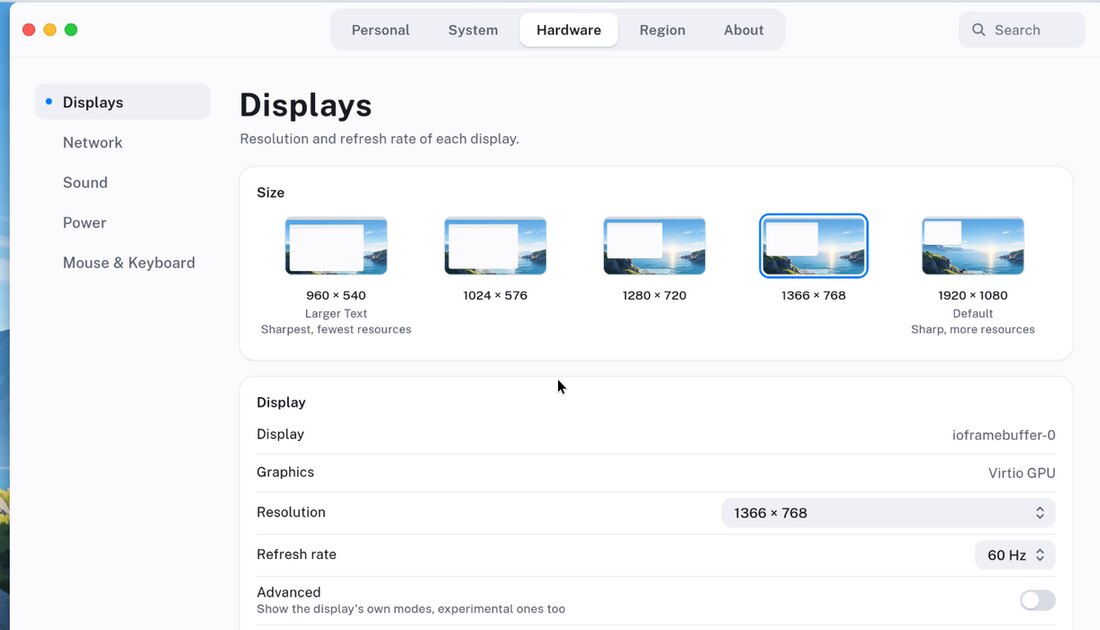
Pick a size that "looks like" 1280 × 800 or 1440 × 900 on a sharp screen, as on a Mac. RefyOS draws everything at twice that size and scales the picture down to the display's own pixels on the GPU, so text and icons stay crisp at every size, not just at 2×.
Looks like
You choose 1440 × 900 in Settings, with a note on which size is sharpest and what each one costs to draw.
Drawn at 2×
Apps draw at 2880 × 1800, with @2x icons and full-resolution text.
Scaled on the GPU
The compositor filters the frame down to the panel's native pixels, e.g. 2560 × 1600.
- Each display its own scale: a window draws at the scale of the screen it is on
- Mixed setups: a HiDPI laptop panel next to a 1× monitor
- HiDPI cursors, sharp at any size, and a pointer size that can follow the scale
- Native modes from the monitor's EDID, and "Default" marked as on a Mac
XNU, from PureDarwin.
The kernel, the boot path and much of the userland come from PureDarwin. We follow its latest upstream branch and build the rest of the system on top.
A compositor on the GPU.
Windows are GPU buffers that the compositor samples directly. Where the GPU can't help, a CPU path still keeps a 4K screen at frame rate.
- GPU compositing by default, CPU fallback automatic
- Window frames as IOSurfaces, zero-copy where possible
- Drawing through Skia, on the GPU or the CPU
- Multiple displays, plugged and unplugged at run time, a menu bar on each
- 3D acceleration in virtual machines (virtio-gpu)
- Native drivers for Intel and AMD GPUs
Metal on GL
Metal apps present into the window's GPU frame without a readback.
Every refresh
Windows draw at most once per display refresh.
Sharp cursors
Drawn at the display's scale.
Lock screen
Protected by the compositor, not by an app.
CoreAudio, in real time.
Audio apps get the low, steady latency they expect: real-time threads, small buffers and a clock taken from the hardware.
- Real-time IOProcs, buffer sizes the app chooses, up to 4096 frames
- Input and output of one device as one duplex device
- Any Intel HD Audio controller, speakers and microphone
- USB Audio Class 1 and 2 interfaces, 32-bit
- Audio Units v2 hosting, AudioFile and ExtAudioFile
Online, and staying there.
Wi-Fi
A system service joins and keeps your networks, prefers a strong 5 GHz access point, and remembers whether the radio was on.
Remembered networks
In the order you set, with passwords in the System keychain, sealed to this computer.
Drivers
Qualcomm Atheros 802.11ac (QCA9377, QCA6174, QCA988x) and Ethernet, with more to come.
Ethernet
Link and address in Settings and the menu bar.
DNS and Bonjour
Name servers follow the network; mDNS for local names.
SSH
OpenSSH for remote work.
Disks, as you'd expect.
Disk images
.dmg files open and mount with hdiutil and DiskImageMounter.
USB and SATA
USB 3 with deep hub chains; internal and external disks told apart.
File systems
ext4 with a journal, and FAT for memory sticks and cameras.
Locked when you leave.
Keychains
Passwords behind SecItem, with access lists; the login password unlocks them.
Authorization
An administrator's password dialog for system changes.
Sandbox
SBPL profiles enforced in the kernel.
Login
PAM, with failed attempts counted across restarts.
Lock screen
From the menu bar or when idle.
Several users
Restarting with others logged in needs an administrator.
Our own code is MPL-2.0 OR BSD-2-Clause. The system image contains no GPL or LGPL code and no closed-source software: every part that didn't fit was rewritten or replaced, file by file. Device firmware ships only where its licence allows redistribution.
Optional downloads stay separate, with their sources where the licence asks for them. Logo, icons and wallpapers are our own artwork, all rights reserved. Sima Sans is under the SIL Open Font License.